The Cabinet Committee (CCEA) of Economic Affairs chaired by Prime Minister Shri Narendra Modi has approved an increase in the minimum support value (MSP) of all Kharif crops for the Government Procurement, Season 2021-22.
The Government has raised the MSP of Kharif crops for the season 2021-22, aimed at ensuring the beneficial value for farmers for their yield. The most sesame (Rs 452 per quintal) as compared to the past year and then the increase in the MSP of the Tür and Ord (Rs 300 per quintal) was recommended. In case of peanuts and nigerseeds, Rs 275 and Rs 235 per quintal has been increased as compared to the past year. The aim of this difference in values is to encourage crop diversification.
The minimum support value of all Kharif crops is as follows:
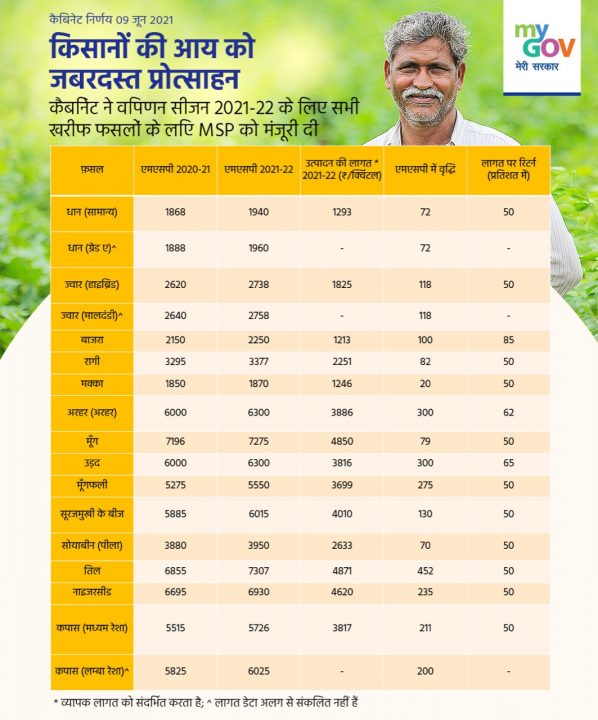
This means the overall cost, which includes expenditure on human labour, bull labour, machine labor, leased ground rent, expenditure on materials used like seed, fertilizer, manure, irrigation charges, equipment and depreciation on agricultural building, interest on working capital, expense on pump set etc., mixed expenses and value of family labor.
^ Cost figures for paddy (grade A), tide (muddy) and cotton (long rays) are not included separately.
Increasing MSP of Kharif crops for Government Procurement, Season 2021-22, in order to declare the determination of MSP at a level of at least 1.5 times from all India weighted average cost (COP) of production in common budget 2018-19, which is aimed at ensuring logically reasonable benefits for farmers. Farmers are likely to have a higher approximate return millet (85 per cent) on their production cost, followed by a fluor (65 per cent) and a trumpet (62 per cent). For the rest of the crops, farmers are estimated to have at least 50 percent return at their cost.
During the last few years, solid efforts towards shifting MSPs in favor of oilseeds, pulses and coarse grains are aimed at encouraging farmers to plant these crops in more part of their farms and adopt the best techniques and agricultural methods, thereby allowing balance in demand-supply. The emphasis on nutrition-rich nutrient grains is to encourage the production of these in such areas, where paddy-wheats cannot be produced without long-term contrasting effects on groundwater.
In addition, the Ambrela Scheme announced by the Government in the year 2018 "Principal Minister Annapayer Income Protection Campaign" (PM-Asha) will increase the beneficial returns for their yield to farmers. The Ambrela Scheme consists of three sub-projects on the experimental basis- Value Support Scheme (PSS), Price Difference Payment Scheme (PDFS) and Private Procurement and Storage Scheme (PPSS)-
दालों के उत्पादन में आत्मनिर्भरता हासिल करने के उद्देश्य से, आगामी खरीफ सीजन 2021 में कार्यान्वयन के लिए विशेष खरीफ रणनीति तैयार की गई है। तुअर, मूंग और उड़द के लिए रकबा और उत्पादकता दोनों बढ़ाने के लिए एक विस्तृत योजना तैयार की गई है। इस रणनीति के तहत, बीजों की सभी उपलब्ध अधिक उपज वाली किस्मों (एचवाईवी) को सहरोपण और एकल फसल के माध्यम से रकबा बढ़ाने के लिए मुफ्त वितरित किया जाएगा। इसी प्रकार, तिलहनों के लिए भारत सरकार ने खरीफ सीजन 2021 में किसानों को मिनी किट्स के रूप में बीजों की ऊंची उपज वाली किस्मों के मुफ्त वितरण की महत्वाकांक्षी योजना को मंजूरी दी है। विशेष खरीफ कार्यक्रम से तिलहन के अंतर्गत अतिरिक्त 6.37 लाख हेक्टेयर क्षेत्र आ जाएगा और इससे 120.26 लाख क्विंटल तिलहन और 24.36 लाख क्विंटल खाद्य तेल पैदा होने की संभावना है।

