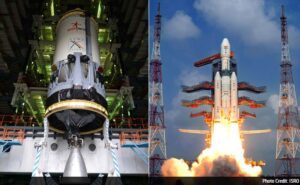
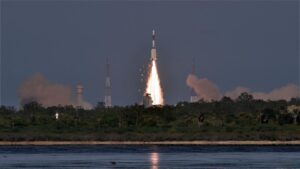
Sriharikota- ISRO’s most powerful satellite launch vehicle GSLV Mark 3D-1 took the first flight on Monday. Its weight is equal to 200 elephants. It was left from the Satish Dhawan Space Centre of Andhra Pradesh. Rocket delivered the country’s largest communication satellite GSAT-19 into space orbit in 16 minutes equal to an elephant. This will lead to the introduction of high speed internet in India over a few years. ISRO said that the new GSLV rocket can lead to space for humans. On the success of this historic mission, Narendra Modi and President Pranab Mukherjee congratulated ISRO.
GSLV Mark III launch ISRO 650
What is the mission?
– ISRO’s most powerful satellite launch vehicle GSLV Mark 3D-1 took the first flight. It took the country’s largest communication satellite GSAT-19 (weight 3136 kg) into space.
What is GSAT-19?
– GSAT-19 is the most weighty satellite prepared in the country. It has been used for Modern Plain Technology. It is equipped with heat pipe, fiber optic gyro, micro-mechanical systems accylerometer, KU-band TTC transponder and lithium ion battery. It costs around Rs 300 crore.
What is the benefit from Communication Satellite?
– In a few years, internet speed will increase in the country. The fastest live streaming will get. Where there is no fiber optical network, there will be advantage.
Launching of GSAT-19 and GSAT-11 Communication Satellites will strengthen Digital India.
What is GSLV?
– GSLV ISRO’s Satellite Launch Vehicle. The full name of which is Geosynchronous Satellite Launch Vehicle. ISRO has developed this rocket. Through this, 11 times have been sent to the Satellite Space since 2001. The last flight was loaded on May 5, 2017, then it took GSAT-9 together.
gsat-9-launched
What is the USP of GSLV Mark 3?
– Launching of GSLV Mark 3 is being seen as a mission to make a big change in space technology. Now India will be able to launch large and heavy satellites in the country without having to dip on other countries. This space can take up to 4 tonnes of weight satellites. Its capacity is doubled by the capacity of two tons of existing GSLV Mark 2.
– Keeps the strength to carry 8 tonnes of weight up to an orbit with a low altitude of the earth. which is considerable from the point of view to India’s crew. ISRO has already made plans to send 2 to 3 members in space. It is awaited to get around $4 billion funds.
Why is it called Fat Boy Satellite?
– The weight of GSLV Mark 3 is 630 tons, which is equal to 200 elephants (one elephant-closer 3 tons). The height is about 42 meters. Its weight is equal to 5 fully filled boeing jumpo aircraft or 200 elephants. That’s why it’s being called Fat Buoy Satellite. It costs Rs.160 crore in making.
What record of ISRO in rocket launching?
– This mission for ISRO will not work easy. India’s record in the first rocket launch has not been something special. The PSLV of ISRO in 1993 was failed in the first launch. Since then its 39 launches have managed.
– GSLV Mk-1 also failed in its first launch in 2001. From then to now, 11 have been launched from which half have managed.
What will benefit India?
The first flight of GSLV Mark 3 can be accomplished in India’s dream of sending a human in space. This Zambio rocket of ISRO keeps capacities of moving humans into space. ISRO’s Cheyman A.S. Kiran Kumar said that if everything was fine in 10 years or at least 6 successful launchings, this rocket can be used as the best option to ‘refer Indians into space’.
Who was the first astronaut from India?
Rakesh Sharma is the name of the first Shekhs of India known in space. Those who had flew during the Soviet Union’s mission on April 2, 1984. Sharma was the pilot of Indian Airforce.
How many countries have this capacities?
– With the success of GSLV Mark 3, India, Russia, the United States and China will reach the world’s fourth country with Human Space Flight Program.
How did India go ahead in Space Industry?
– skip record satellites. ISRO, which prepares satellite, costs less. That’s why it’s going ahead in the global space industry. India had sent its mission on Mars in less than the cost of a Hollywood movie. ISRO has strengthened the holding in the space launching market of several crore dollars.
GSAT-11 will also be left the same year
– Kiran Kumar, chairman of ISRO reported that GSAT-11 will also be left after GSAT-19. These two satellite game changers are being considered. These revolutionary changes will occur in communication. The launching of these will be extremely important step towards Digital India. These high-speed internet service will play a key role in making communications bearing.
– Space Application Centre, Ahmedabad Director Tapan Misra, told that if it was successful launching, the only GSAT-19 satellite space will be equal to the group of 6-7 community satellites of the already existing old variety. There are 13 communication satellites out of 41 Indian Satellites present in space today.
– According to Misra, it will be left GSAT-11 in the year. The high-quality internet, phone, and video service will begin as both of these satellites start. The effective data rate of the GSAT Satellites already existing in the space is one gigabyte per second, while GSAT-19 per second is worth transferring data at a rate of 4 gigabyte data and Thirteen gigabyte per second.